

1. The Digital Backbone Needs a New Build Team
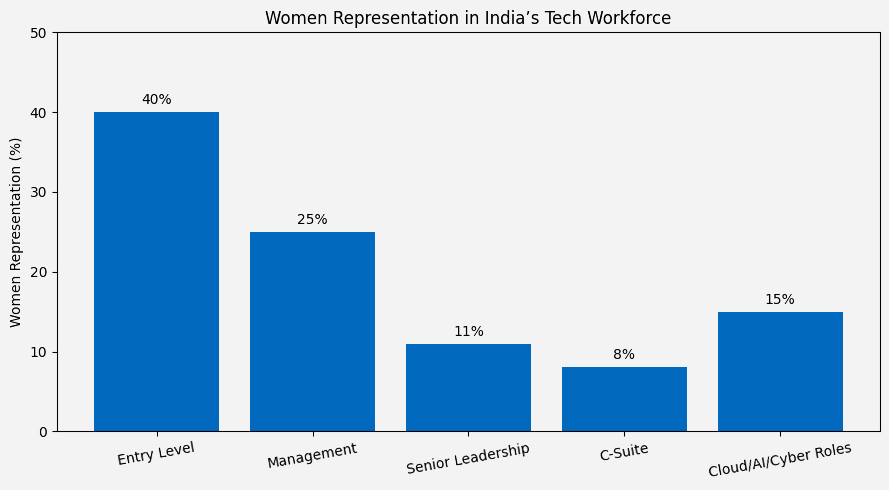
India’s digital economy is racing toward a trillion-dollar future. By 2030, the IT workforce will swell from 5.4 million to 7.5 million professionals, with over one million new jobs in cloud, AI, and cybersecurity. But there’s a crack in this ambitious blueprint: the quiet exit of women from mid-level tech roles. Today, women make up 35–38% of India’s IT workforce. At the entry level, the picture looks promising: 40% of junior roles are held by women. Yet as you move up, the numbers shrink. Only 25% of women in tech hold management roles. Just 11% reach senior leadership, and a mere 8% sit in C-suites. Managed services and IT infrastructure offer a fresh arena for change. Unlike legacy software roles, fields like cloud engineering and data centre management are newer, more meritocratic, and hungry for diverse talent. But in niche technical roles such as cloud, AI, and cybersecurity, women hold just 14–16%, leaving a 20– 25% skills gap.
2. The Data Speaks. Where Are Women in Indian IT Infrastructure?
The “leaky pipeline” is real. Women start strong, then vanish. At mid-level, representation drops to 18– 30%. By senior management, it’s 11%. Boardroom? 8%. Even top IT firms show declines. TCS’s female workforce share dipped from 35.6% (FY24) to 35.3% (FY25); Infosys from 39.3% to 39%. The mid-career drop-off is brutal: 30–40% of women quit by mid-management, citing family, marriage, and lack of flexibility. A FICCI FLO report (March 2026) found that 210,000 women in tech are on career breaks, and nearly 58% are re-employable.
3. Women Rewiring the Infrastructure Stack
Despite these barriers, Indian women are building, scaling, and leading some of the country’s most sophisticated IT infrastructure operations.
Vaishali Dake, Director, The Argon Company, embodies the transformative power of technology and sheer determination. Having built a successful career in IT infrastructure management from humble beginnings, Dake now leads a company that provides managed IT services to enterprises across India. Her journey from the constraints of a Mumbai slum to global IT leadership demonstrates that talent exists everywhere, but opportunity remains the missing variable.
Women Tech Leaders at Wells Fargo India Centre, meanwhile, are quietly revolutionizing how the financial giant manages its global infrastructure remotely. From enabling seamless cloud migrations to orchestrating disaster recovery protocols across continents, these women are proving that remote infrastructure management is not only possible but can be executed with precision. Their work challenges the outdated notion that infrastructure roles require constant on-site presence, opening pathways for thousands of women who need flexibility but refuse to compromise on technical excellence.

4. Technical Support- The Overlooked Frontier
For too long, help desk and technical support roles have been dismissed as career dead-ends. Yet for many women in Indian IT, these positions represent precisely the opposite. Women who master the art of troubleshooting, customer empathy, and systems thinking in support roles develop the foundational knowledge required for cloud engineering, network architecture, and security operations.
Government and industry have begun to recognise this potential. The National Skill Development Corporation (NSDC) has collaborated with companies like Quest Global to deliver targeted upskilling in data analytics, cloud computing, and network security for underserved women students. IBM’s STEM for Girls program has reached over 12,000 young women. These initiatives are strategic workforce development for an economy.
5. Call to Action And Future Outlook
The opportunity before India is immense. Over one million infrastructure jobs are expected by 2030, and the IT workforce is projected to expand to 7.5 million; the country cannot afford to leave half its talent on the sidelines. What women can do: Pursue continuous upskilling in high-demand domains like cloud, AI, and cybersecurity; join professional communities such as Women in Tech India and NASSCOM’s diversity networks; and actively seek mentorship and sponsorship from established leaders who can open doors to high-visibility projects.
Future forecast: India needs to bridge the 20 to 25 per cent skills gap in job-ready women for niche technical roles. As the electronics and IT minister noted, with 60 to 70 per cent of women in electronics manufacturing already driving six-fold growth, the precedent is clear: inclusive workforces build stronger economies.India’s digital backbone is being constructed today. The question is not whether women can lead it they have already proven they do. The question is whether the industry will finally break the code that has kept them on the margins. The answer will determine whether India becomes a truly inclusive digital superpower or falls short of its extraordinary potential.